History
St. Andrews, located in Antigonish County, Nova Scotia, lies adjacent to the vibrant Paqtnkek Mi’kmaw Nation, a community of approximately 600 Mi’kmaq people as of 2025. (Note that Paqtnkek is pronounced “buck-n-keg”.) Mi’kmaq people have lived in what is now known as St. Andrews and the wider area for thousands of years. The rivers – such as the beautiful South River – as well as estuaries and nearby sea have been and remain deeply important to the Mi’kmaq people.
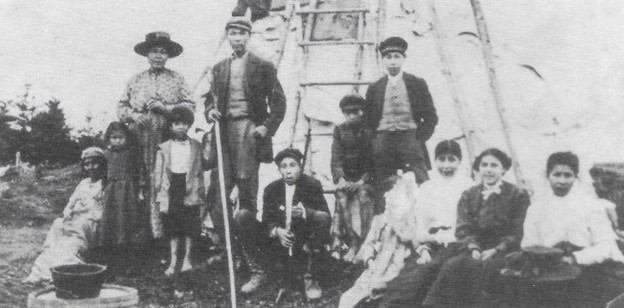
Mi’kmaq families living at Antigonish Landing. Source: Macdonald, 2000.
The community of St. Andrews exists today in part thanks to the Peace and Friendship Treaties signed prior to 1779 to permit peace and cooperation between the British Crown, First Nations and non-Aboriginal (settler) people across the Canadian Maritimes. Unlike some treaties in other parts of Canada, the Peace and Friendship Treaties did not involve ceding (surrendering) the Mi’kmaq people’s traditional land and resources. The Partnership respectfully recognizes our treaty obligations and seeks to pursue projects aligned with sustainability and inclusivity.
Early Settlement by Scottish Immigrants
St. Andrews, located in Antigonish County, Nova Scotia, lies adjacent to the vibrant Paqtnkek Mi’kmaw Nation, a community of approximately 600 Mi’kmaq people as of 2025. (Note that Paqtnkek is pronounced “buck-n-keg”.) Mi’kmaq people have lived in what is now known as St. Andrews and the wider area for thousands of years. The rivers – such as the beautiful South River – as well as estuaries and nearby sea have been and remain deeply important to the Mi’kmaq people.
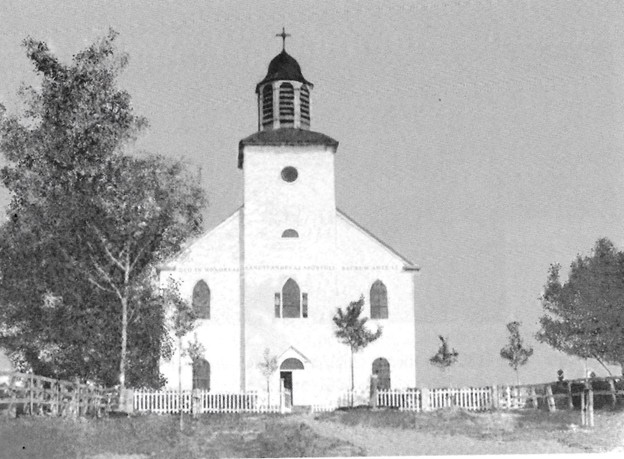
St. Andrews church, circa 1900. (Source: Macdonald, 2000)
The early Scottish settler families cleared land for farming and built barns, houses, roads, and bridges. They built a chapel and eventually a large church in 1845. Nine schools were established, one for each district of the community. The largest of these schools, the St. Andrews Grammar School, built in 1838, is considered by many to be the foundation for what is now St. Francis Xavier University in Antigonish. The community built these assets prior to the creation of municipal governments in 1879, demonstrating a common vision and community spirit.
Growth Period: 1800’s
The period between 1801 and Confederation in 1867 was a boom time for the local economy of St. Andrews. The population steadily increased as European immigrants settled in the area. Demand grew for local agricultural and forest products which predominate in the community. Water from the South River, which runs through St. Andrews, was used to power sawmills for local lumber, gristmills for flour, and carding mills for wool. A cheese factory, a tannery and a shingle mill were established and several shops supplied general merchandise as well as blacksmithing and shoemaking services.
A period of economic decline followed in 1873 lasting until 1896. Many adult children of local families migrated for work to the northeastern United States or western Canada.
A New Century: Building Through Cooperation
In the 20th century, those who remained in St. Andrews found innovative ways to build community.
Cooperatives: Led by Dr. Hugh MacPherson, born in the St. Andrews area, the community established a wool co-operative in 1914, and in 1917, the first co-operative store in eastern Canada. The co-op store was a centre of innovation, allowing cash, credit and barter. An older community member, Mary “Tommy” Chisholm, remembers community members trading butter for kerosene. These early experiences with cooperative activity in St. Andrews helped inspire a group of priests – who were also professors at nearby St. Francis Xavier University – to promote cooperatives throughout northeastern Nova Scotia under the banner of the ‘Antigonish Movement’ in the 1930s and 1940s (Boyd, 1949).
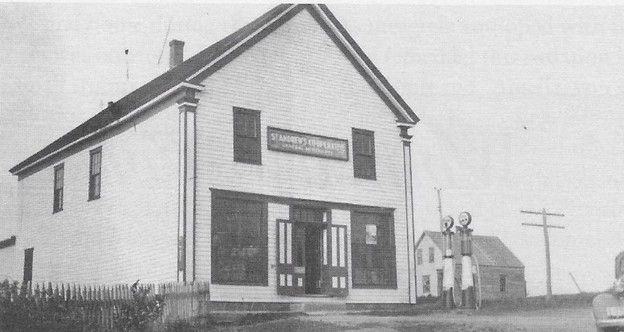
St. Andrews cooperative store, 1940’s (Source: Macdonald, 2000)
Hospitalization Plan: Another example of cooperative initiative, the Hospitalization Plan (or St. Andrews Pioneers Public Hospitalization Plan) was established in 1936 through the St. Andrews co-operative store. The plan addressed a key problem facing many community members in the years prior to Medicare (also known as universal health care) in Canada – unpaid medical bills due to unaffordable and expensive private health care. The plan involved group membership whereby the cooperative store paid St. Martha’s Hospital on a quarterly basis in return for medical services for members and their families.
Agricultural Innovation: H. MacPherson (co-op store manager ), the first recognized soil scientist east of Ontario also spearheaded efforts to address soil acidity, which predominates in the region’s agricultural soil. He introduced marl from local deposits to lower soil acidity and encouraged the use of both organic and chemical fertilizers. Under his leadership, St. Andrews established a creamery and organized a grading and marketing system for lambs.
Electricity: The people of St. Andrews provided volunteer labour and local poles to run a 40 kilometer extension line to their community from Antigonish, where electricity arrived in 1931. The community also set up a mutual telephone system in which each household contributed funds and labour to help string wires. A house was built for a switchboard operator in lieu of having to pay for each call.
Credit Union: A credit union was established in St. Andrews in 1933. The first loans issued by the St. Andrews Credit Union rarely exceeded $100, but these loans were crucial for the purchasing farm equipment and livestock and building barns and homes .
Dutch Immigrants Arrive
In the aftermath of the Second World War, thousands of Dutch farming families arrived in Canada seeking new agricultural opportunities. Between 1950 and 1956, 110 Dutch families arrived within the Antigonish Diocese, of which 23 settled in St. Andrews.
The Dutch immigrants deployed intensive farming techniques to transform abandoned land into productive farms.
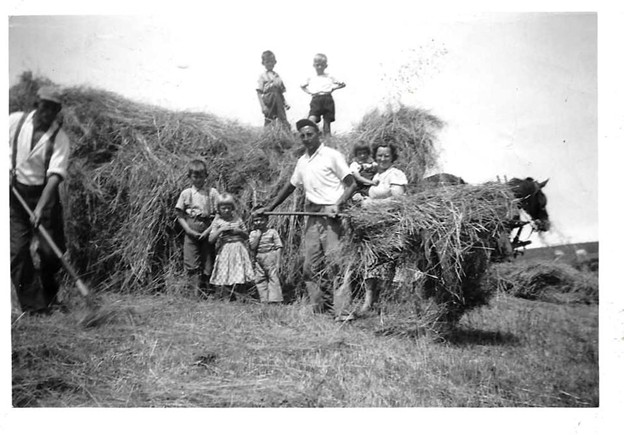
Dutch immigrant families to St. Andrews, the van den Heuvels and Daemens, are shown haying by hand together in 1953.
Yet many struggled at first and relied on financial and other support from the parish priest and their Scottish-Canadian neighbours.
Many long-time residents of St. Andrews in the 1950s and 1960s volunteered to help Dutch newcomers build a barn or replace a roof (MacDonald, 2000). Within a generation, the Dutch had contributed to reshaping the dairy industry in the region. Until the 1950s, dairy production in Northeastern Nova Scotia had been very small scale with most households owning their own cow. The Dutch experience in dairy farming helped develop the dairy industry into one of the main engines of the St. Andrews economy.
Citizen-Driven Development: St. Andrews Today
Residents of St. Andrews have a history of collaboration and cooperation, and include many strong and active leaders as well as individuals with wide-ranging skills. As is evident from the examples already given, these unique strengths and skills keep improving our community for the future.
The people of St. Andrews have continued to build this community with a solid base of cooperation and volunteerism.
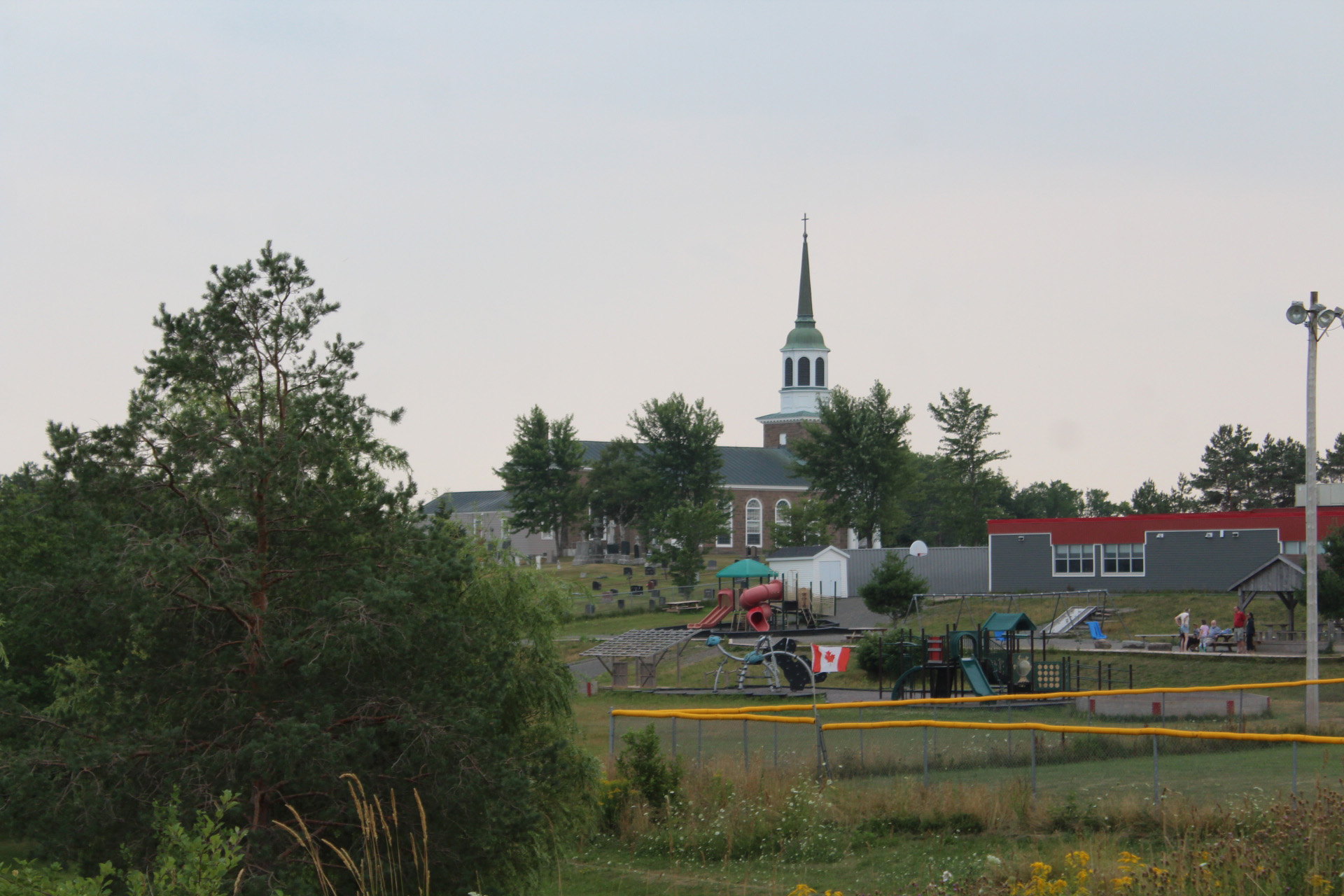
- Softball fields were built on land donated by a community member.
- The church and six cemeteries were upgraded.
- A fire hall was established & expanded.
- In 1987, St. Andrews hosted its first Homecoming weekend and the theme was “St. Andrews Pride, Keep It Alive!”
- Highlander Curling Club rink (1991) built.
- Community Center (1993) built.
- In 2000, a Parish Council committee formed to set up a seniors’ housing committee that later became the St. Andrews Seniors’ Housing Association (SASHA). SASHA constructed a 16 apartment facility in a staged process again utilizing volunteers and local business contributions.
- A Community Partnership Association was formed in 2009 which launched a community website and developed a Strategic Plan.
St. Andrews Today
These successes are built on a set of values comprising self-sufficiency, community spirit, and care for others. By pooling resources, ideas, and talents, the people of St. Andrews have built tangible community services that are unusual for a community of its size. Past successes have motivated residents to continue with new projects, as well as inspired confidence in local partners and investors, both in government and in the private sector.
To learn more about the community and its volunteer spirit, watch By Their Own Hands, a 20-minute film created by the Coady International Institute (based at St. Francis Xavier University). The film explores reasons why this community has been able to muster active and enthusiastic volunteers for ambitious community initiatives and has maintained a thriving community into the 21st century. Each year, participants of the Coady Institute’s community development courses visit St. Andrews to interview community leaders and to tour its facilities.
St. Andrews recognizes its history, tradition and cultural heritage in a myriad of ways. The St. Andrews church is decorated with tartan cloth on its balconies and beams. St. Andrews Day has been celebrated with a Scottish concert with many young entertainers, showing an appreciation for their Scottish heritage.
Youth are included in the community in many ways. For example, one of the 4-H Clubs does an annual village clean-up. During the annual Christmas Tree lighting, held at SASHA, the St. Andrews School & 4-H Club sing Christmas carols for the seniors.
Most people are willing to join in a community effort if they are personally invited to do so. This is how people, who might not otherwise get involved, become included in various community projects. This participation ensures they get to know their neighbours and gives them a sense of belonging.
Several new projects and study groups show a willingness to foster a respect for the environment. Recent examples include learning about organic gardening and alternative energy sources, as well as pursuing the goal of becoming a Low Carbon Community. Three community facilities have installed solar energy systems.
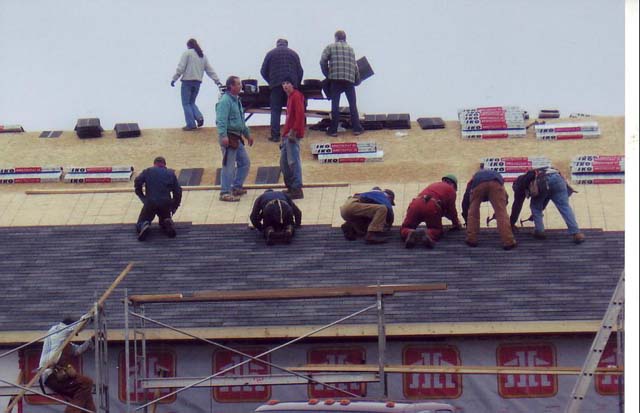
St. Andrews community volunteers install a roof on a community facility.
Projects such as these will lead the community into the future. St. Andrews will endure as the community and the people that live within it continue to grow and develop.
There are three new subdivisions in St. Andrews, and many young couples are choosing to live here because it is a great place to raise a family.
Sources Cited:
- Boyd, 1949
- Macdonald, H. Joseph. (2000). St. Andrews Then and Now, Antigonish, NS: The Casket.
- Stanley-Blackwell, Laurie C.C. & MacLean, R.A. (2004). Historic Antigonish: Town and County, Halifax: Nimbus Press.